
A crane game is a popular arcade game where players control a mechanical claw to grab prizes. You can find these machines in shopping malls, arcades, family entertainment centers, and amusement venues.
Winning takes more than luck. Understanding claw movement, prize positioning, machine types, and grabbing techniques can help you make smarter attempts.
What Is a Crane Game?
A crane game, also called a claw machine, is an arcade prize game that uses a mechanical claw to pick up objects. Players move the claw using a joystick or directional buttons.
The goal is to grab a prize and drop it into the collection chute. Common prizes include plush toys, stuffed animals, anime figures, collectibles, candy, and small toys.
What Is the Meaning of a Crane Game?
The name comes from the crane-like mechanism inside the machine. A mechanical arm moves across the cabinet, lowers its claw, and attempts to lift an object.
Unlike a construction crane, an arcade crane game is designed for entertainment and prize collection.
Crane Game vs. Claw Machine vs. UFO Catcher
These names often describe similar arcade games.
- Crane game: A general name for machines that use a mechanical claw to collect prizes.
- Claw machine: A common American term for the same type of arcade attraction.
- UFO Catcher: A name strongly associated with SEGA’s Japanese crane game machines.
Some machines have different claw designs, prize arrangements, and controls. Their gameplay can also vary.
A Brief History of Crane Games
Crane-style amusement machines developed from older mechanical prize and vending attractions.
SEGA introduced its famous UFO CATCHER in 1985, helping establish crane games as a major part of Japanese arcade culture.
Today, players can find crane machines in American arcades, Japanese game centers, shopping malls, and online platforms.
How Do Crane Games Work?
Crane games use a mechanical system to move a claw across a prize area. Players control its position before activating the drop mechanism.
The claw lowers, closes around an object, and attempts to lift it. If the prize reaches the winning chute, the player can collect it.
Understanding the Crane Game Mechanism
A typical arcade crane machine contains several important components:
- Mechanical claw: Grabs or moves the prize.
- Joystick: Controls the claw’s direction on supported machines.
- Directional buttons: Move the claw along available axes.
- Gantry: Supports and guides the moving mechanism.
- Motor: Powers the claw’s movement.
- Lifting cable: Raises and lowers the claw.
- Prize chute: Allows successful prizes to reach the collection area.
- Control system: Manages movement, timing, and machine functions.
Not every machine uses the same control layout or mechanical design.
How Does the Claw Grab and Release Prizes?
When a player activates the drop control, the claw moves downward. Its prongs close around the selected object.
The machine then raises the claw and carries it toward the prize chute.
A prize may slip because of its weight, shape, surface, or position. The claw may also have limited gripping strength.
This is why choosing a suitable target matters.
Do Crane Games Use Skill or Luck?
Crane games involve both player skill and chance.
Skill affects how accurately you position the claw, choose a prize, and understand its shape. Machine settings also affect the strength and behavior of the claw.
Some machines use programmed payout-related settings. Others provide more consistent gripping behavior.
No single strategy guarantees a win across every machine.
Why Does the Claw Sometimes Drop the Prize?
Several factors can cause a claw to release a prize before reaching the chute:
- The object is too heavy.
- The claw does not surround the prize properly.
- The object has a slippery surface.
- Its weight is unevenly distributed.
- The prongs cannot maintain a secure grip.
- Machine settings limit gripping strength.
Sometimes the claw simply moves an object without lifting it completely.
Different Types of Crane Games You Should Know
Crane machines come in different sizes and designs. Their claw mechanisms and prize arrangements can change how players approach each game.
Two-Pronged Crane Games
A two-pronged claw machine uses two arms to grab or move prizes.
These machines often require careful positioning. Players may use the arms to lift, push, or shift an object toward the winning area.
The technique depends on the prize’s shape and placement.
Three-Pronged Claw Machines
Three-pronged machines use three arms arranged around a central point.
They are common in machines designed for plush toys and other small prizes. The additional arm can help surround an object, but it does not guarantee a stronger grip.
Mini Crane Games
Mini crane machines have smaller cabinets and compact prize areas.
They commonly contain candy, capsules, small toys, and miniature collectibles. Their smaller size makes them suitable for shopping centers and entertainment spaces.
Large Crane Games
Large crane machines can hold oversized plush toys and bigger prizes.
Their larger claws and prize compartments create different challenges. Players need to consider the prize’s weight, dimensions, and available gripping points.
Online Crane Games
Online crane games allow players to control physical machines through a website or mobile application.
Some platforms provide a live camera view. Players use digital controls to move the actual claw.
Other online games simulate crane machine gameplay without operating a physical machine.
How to Play a Crane Game: Step-by-Step Guide
Playing a crane game is simple once you understand its controls. However, choosing the right prize and positioning the claw requires attention.
Step 1: Choose the Right Crane Machine
Start by examining the available prizes.
Look for objects near the winning chute or prizes with enough space around them. Avoid targets trapped under several other objects.
Check the machine’s instructions and cost per attempt before playing.
Step 2: Insert Coins or Make a Payment
Most arcade crane games accept coins, tokens, or supported cashless payments.
Follow the machine’s instructions to activate a game. Check the timer because some machines provide limited movement time.
Step 3: Study the Prize Position
Look at the prize from different angles.
Check its size, weight, shape, and position. Identify whether it can be lifted directly or needs to be moved first.
Step 4: Move the Claw Into Position
Use the joystick or directional buttons to move the claw.
Align it with the intended grabbing point. If the machine has front and side viewing angles, use both to check its position.
Step 5: Lower the Claw and Grab the Prize
Activate the drop control when the claw is correctly positioned.
The claw will descend and close around the object. Its ability to hold the prize depends on the machine and the target’s shape.
Step 6: Watch the Prize Move Toward the Chute
The claw will attempt to lift and carry the object.
Watch its movement carefully. A prize that slips may still move closer to the winning opening.
Step 7: Collect Your Prize
If the object reaches the collection chute, open the retrieval door and take your prize.
If the prize becomes stuck, ask arcade staff for help instead of reaching inside the machine.
Best Crane Game Tips for Beginners

New players often focus only on the claw. However, choosing the right prize is just as important as positioning the mechanism.
Observe the Machine Before Playing
Watch a few attempts before spending money.
Notice how the claw grips objects and whether it drops them during movement. Also, observe how prizes respond when the claw pushes or lifts them.
Choose Easy-to-Win Prizes
Look for prizes that are:
- Close to the winning chute.
- Small enough for the claw.
- Light enough to move.
- Positioned with accessible edges.
- Not trapped beneath other prizes.
A well-positioned prize can be easier to move than a large object buried in a pile.
Check the Claw Position From Different Angles
Some machines provide front and side viewing windows.
Use both angles to judge the claw’s position. A claw that looks centered from the front may be poorly aligned from the side.
Understand Prize Weight and Balance
A prize’s center of mass affects how it moves when lifted.
For example, a stuffed animal with a large head may tilt differently from a compact plush toy.
Look for a position that allows the claw to support the object without causing it to rotate or slip.
Learn the Machine’s Controls
Read the instructions before starting.
Some machines use joysticks, while others have separate directional buttons. Certain machines also allow players to adjust or stop the claw during movement.
Set a Budget Before You Start
Decide how much you are willing to spend.
Avoid increasing your budget because the price has almost dropped. Treat each attempt as entertainment rather than a guaranteed purchase.
Read Also: Diamondbacks Game Today: Schedule, Start Time, and How to Watch
Crane Game Tricks and Winning Strategies That Actually Help
Different prizes require different techniques. Understanding when to grab, push, pull, or rotate an object can help you make better decisions.
The Center-Grabbing Technique
The center-grabbing technique works best when a prize has a balanced shape and enough room for the claw.
Position the claw around the object’s center of mass. This may help distribute the gripping force more evenly.
However, the center is not always the best target. Some prizes need to be lifted from an edge or moved before they can reach the chute.
The Edge-Grabbing Technique
Edge grabbing involves positioning the claw near an exposed part of the prize.
It can help lift one side of a boxed object or shift it toward the opening.
This approach is useful when the prize cannot be lifted directly.
The Push and Drag Technique
Sometimes pushing a prize is more effective than lifting it.
Use the claw to move an object toward the winning chute or create a better position for the next attempt.
This technique is particularly useful when prizes are resting against other objects.
The Hooking Technique
Some prizes have exposed tags, loops, straps, or openings.
A claw prong may catch one of these parts and move the object.
However, the target must be accessible, and the claw must have enough room to make contact.
The Rotation Technique
A boxed prize may be difficult to grab because of its original position.
Instead of lifting it, use the claw to rotate it gradually. Changing its angle can expose a better grabbing point or move it closer to the opening.
The Two-Angle Positioning Strategy
Use the front and side views to check alignment before dropping the claw.
This is especially helpful when the prize sits between bars or near the cabinet’s edges.
The Stop Button Technique
Some crane machines include a control that allows players to stop or adjust the claw during descent.
When available, this feature can help with precise positioning.
Always check the machine’s instructions because not every model supports this function.
The One-Move-at-a-Time Strategy
Avoid repeating the same movement when it does not change the prize’s position.
Observe the result of each attempt. Then decide whether to grab, push, rotate, or target another object.
Crane Game Prize Setups and How to Win Each One
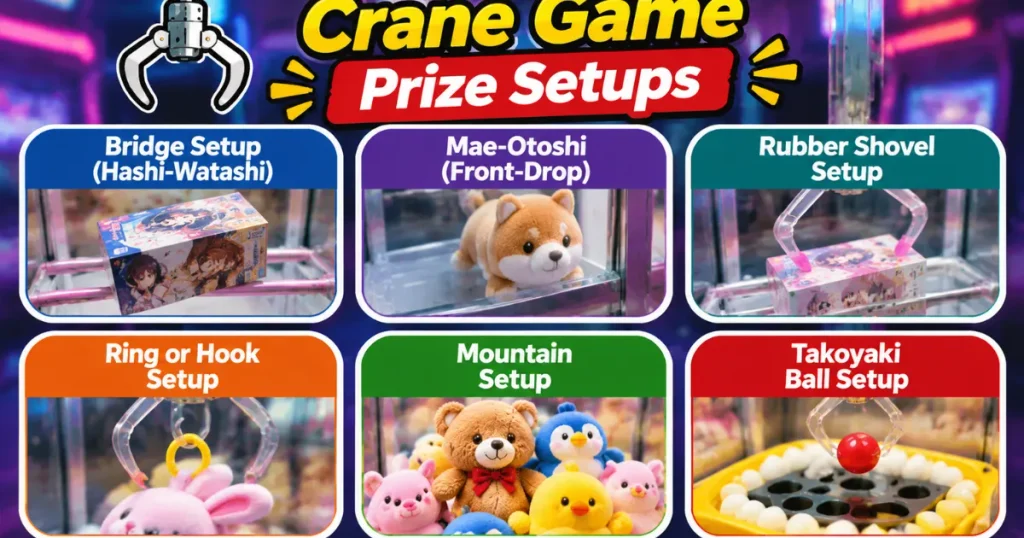
Many crane games use special prize arrangements. These setups change how objects move and which techniques are useful.
Bridge Setup (Hashi-Watashi)
Hashi-Watashi is a Japanese crane game setup where prizes rest across two supporting bars.
Players try to move a prize across the bars until it falls into the winning area.
Rather than lifting the entire object, players may need to shift one side at a time. Positioning and gradual movement are important.
Mae-Otoshi (Front-Drop Setup)
Mae-Otoshi generally refers to a front-drop style arrangement.
The prize is positioned so players can work toward moving it over the front edge. Pushing and shifting may be more useful than attempting a direct lift.
Rubber Shovel Setup
A rubber shovel setup uses a broad pushing mechanism to move prizes.
The mechanism may push objects toward a target opening. Players need to understand where the shovel makes contact and how the prize responds.
Ring or Hook Setup
Some machines use rings or hooks attached to prizes.
The goal is to position the claw around the target and move the ring toward its release point.
Accuracy matters because a poorly positioned claw may push the ring away instead.
Mountain Setup
Mountain setups feature prizes arranged in a raised pile.
The objects can shift when the claw makes contact. Players need to consider stability and avoid targeting objects that are tightly trapped.
Corner Balance Drop
In a corner balance setup, an object rests on an edge or corner.
Small movements can change its balance. Players may use pushing or rotation to move the prize toward the winning opening.
Takoyaki Ball Setup
A Takoyaki crane game uses small balls and target holes.
Players attempt to pick up a ball and place it into a winning position. This setup relies more on precision and controlled placement than conventional plush toy grabbing.
Best Strategies for Winning Different Crane Game Prizes
A technique that works for a plush toy may not work for a boxed figure. The prize’s shape and weight should guide your approach.
How to Win Plush Toys and Stuffed Animals
Look for exposed arms, legs, ears, or other areas that the claw can surround.
Large round plush toys may be difficult to lift because their shape makes them slip. Smaller toys with accessible gripping points may be easier to move.
How to Win Boxed Figures and Collectibles
Check how the box rests on the supporting bars.
Try to identify an exposed corner or edge. Pushing or rotating the box may create a better position than grabbing its center.
How to Win Anime Figures
Many arcade anime figures come in cardboard display boxes.
Pay attention to their weight distribution and dimensions. A box with a heavy base may tilt differently from one with evenly distributed weight.
How to Win Small Toys and Capsules
Small capsules can roll or slip when touched.
Look for an object with enough surrounding space. The claw may work better when it can reach around the capsule rather than simply pressing against its surface.
How to Win Bags, Posters, and Flat Prizes
Flat prizes are difficult because they offer little depth for gripping.
Look for exposed corners, straps, or loops. Hooking or dragging may be more useful than attempting a direct lift.
Common Crane Game Mistakes That Prevent You From Winning
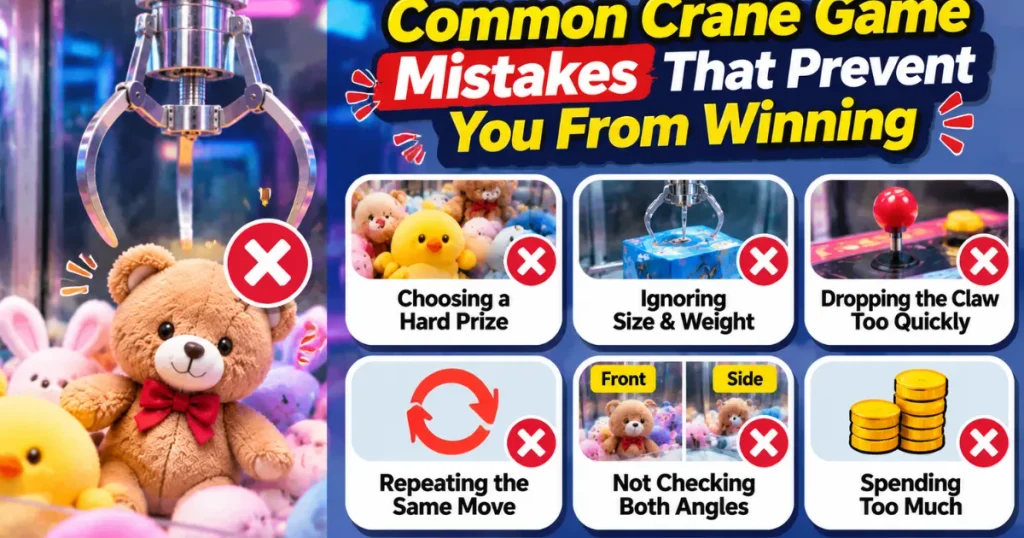
Avoiding common mistakes can help you use your attempts more carefully.
Choosing a Prize That Is Too Difficult
A prize trapped under several objects may be difficult to move. Start with something more accessible.
Ignoring the Prize’s Weight and Shape
A large object may not fit inside the claw. Check its dimensions and balance before choosing it.
Dropping the Claw Without Checking Alignment
Poor positioning can cause the claw to miss the prize or touch only one side.
Repeating the Same Failed Strategy
If the prize does not move, consider a different approach. Try repositioning it instead of repeating an unsuccessful grab.
Playing Without Observing the Machine
Watching the claw’s behavior can reveal how the machine handles different prizes.
Ignoring the Side View
A target may look correctly positioned from the front but remain misaligned from the side.
Spending Too Much on One Prize
A nearly successful attempt does not guarantee the next one will work. Set a limit and follow it.
Believing Every Crane Machine Has the Same Settings
Claw strength, movement speed, and game rules vary. Learn the specific machine before playing.
Are Crane Games Rigged?
Not every crane game operates in the same way.
Some machines use adjustable settings that affect claw strength and gripping behavior. Others may use programmed payout-related controls.
Prize positioning and mechanical design also affect how difficult a game feels.
A weak grip does not automatically prove that a machine is rigged. However, players should understand the rules and payment conditions before spending money.
What Is a Payout Setting in a Crane Game?
A payout setting is a machine configuration that may affect how often or under what conditions a prize can be won.
Some commercial crane machines offer adjustable settings. Their exact operation depends on the model and configuration.
There is no single payout formula that applies to every crane machine.
Can You Win a Crane Game Every Time?
No. Even experienced players cannot guarantee a prize.
Good positioning and prize selection can improve decision-making, but machine settings, grip strength, and object movement still affect the result.
Where Can You Play Crane Games in the USA?
Crane games are available in many American entertainment venues.
Some popular places to look include:
- Dave & Buster’s: A large entertainment chain with arcade games.
- Round1: An entertainment venue known for arcade games and prize machines.
- Main Event: A family entertainment center with arcade attractions.
- Shopping malls: Many malls have dedicated arcade areas.
- Local arcades: Independent businesses may offer different claw machine styles.
Machine availability and prize selections vary by location.
Online Crane Games vs. Physical Arcade Crane Games
Players can now enjoy crane games without visiting a traditional arcade.
However, online and physical machines offer different experiences.
How Online Crane Games Work
Online platforms may connect players to physical crane machines through live video.
Players use on-screen controls to move the claw. The machine operates remotely, and successful prizes may be shipped to the player’s address.
Other platforms offer simulated gameplay without physical prize delivery.
Benefits of Online Crane Games
- Play from home.
- Access machines in different locations.
- Explore different prize selections.
- Use smartphones or computers.
- Avoid traveling to an arcade.
Limitations of Online Crane Games
- Internet connection requirements.
- Possible shipping costs.
- Platform-specific payment systems.
- Limited physical interaction.
- Different prize delivery rules.
Are Online Crane Games Worth Playing?
That depends on your budget and expectations.
Check the platform’s pricing, prize delivery conditions, shipping fees, and refund policies before purchasing credits or attempts.
Also, distinguish between a real remote-controlled machine and a simulated mobile game.
How to Play Crane Games Responsibly
Crane games are designed for entertainment. They should not become a way to recover money already spent.
Follow these simple guidelines:
- Set a spending limit before playing.
- Treat each attempt as entertainment.
- Avoid chasing a prize after repeated failures.
- Take breaks when necessary.
- Read the machine’s rules.
- Help children understand that winning is not guaranteed.
- Stop when you reach your budget.
Responsible play makes arcade experiences more enjoyable.
What Is a Human Crane Game?
A human crane game is a large-scale attraction where a person takes the place of the mechanical claw.
Participants are usually supported by a harness or lifting system. They are suspended above a prize area and guided by event equipment or operators.
These attractions may appear at parties, fairs, festivals, and entertainment events.
Unlike traditional arcade machines, human crane games require proper equipment and trained supervision.
How Does a Human Crane Game Work?
The participant is secured using an appropriate safety harness.
A lifting system positions the participant above the prize area. Depending on the attraction, the person may try to collect objects using their hands or a specially designed mechanism.
Trained operators must control the equipment and follow safety procedures.
Human Crane Game vs. Traditional Crane Game
A traditional crane game uses a mechanical claw to collect prizes.
A human crane game uses a suspended participant as part of the attraction. Both share the same basic prize-collection idea, but their equipment and safety requirements are very different.
FAQ’s
What Is a Crane Game Called?
A crane game is also called a claw machine, claw crane, skill crane, or UFO Catcher. The exact name depends on the machine and region. UFO Catcher is especially associated with SEGA’s Japanese arcade machines.
How Do You Play the Crane Game?
Insert the required payment and use the joystick or directional buttons to position the claw. Lower it over a suitable prize and attempt to grab or move it toward the collection chute. If successful, collect your prize from the retrieval area.
What Is the Meaning of Crane Game?
A crane game is an arcade prize machine that uses a mechanical claw to lift or move objects. Its name comes from the crane-like lifting mechanism.
What Is a Human Crane Game?
A human crane game is an entertainment attraction where a participant is suspended above a prize area using a harness and lifting system. It recreates the basic idea of a crane machine on a much larger scale.
How Can You Increase Your Chances of Winning a Crane Game?
Choose accessible prizes, study their position, check the claw alignment, and use a suitable technique. Understanding the machine can help you make better attempts, although no strategy guarantees a win.
Are Crane Games Based on Skill or Luck?
Crane games involve both skill and chance. Players control positioning and prize selection, while machine settings and mechanical conditions also influence the outcome.
Why Does the Claw Drop the Prize?
The claw may drop a prize because of limited grip strength, poor positioning, uneven weight distribution, or a slippery surface. Some machines also use adjustable gripping settings.
What Is the Easiest Prize to Win in a Claw Machine?
Small, lightweight prizes with accessible gripping points can be easier to move. However, the actual difficulty depends on the claw, prize arrangement, and machine settings.
Do All Crane Games Have Weak Claws?
No. Claw strength varies between machines and configurations. Some provide consistent gripping force, while others use adjustable or programmed settings.
Conclusion
Winning a crane game requires careful observation and smart positioning. Understanding claw mechanics, prize weight, and different setups can help you make better attempts.
Whether you play at an American arcade, a Japanese game center, or an online platform, remember that no trick guarantees a prize. Choose suitable targets, manage your budget, and enjoy the game.