
The Trouble board game is a classic family game where players race to move four colored pegs around the board and reach their Finish zone. Its famous Pop-O-Matic dice roller makes every turn simple and exciting.
Whether you are learning the rules for the first time or looking for better ways to play, this guide explains the Trouble game setup, movement rules, special spaces, and practical winning tips.
What Is the Trouble Board Game?
Each player gets four colored pegs. The goal is to move all four pegs around the board and into the matching Finish zone before the other players.
The game’s most recognizable feature is the Pop-O-Matic bubble, a built-in dice roller that lets players roll without handling or losing a separate die.
What Comes in the Trouble Board Game Box?
The classic Trouble game includes the main components needed to play:
- One gameboard with a built-in Pop-O-Matic dice roller.
- 16 colored pegs.
- Four sets of four matching pegs.
- Game instructions.
The board has four colored player areas, a shared movement track, starting positions, and separate Finish zones.
Understanding the Trouble Gameboard
Each player chooses a color and keeps their four pegs in the matching Home area before starting.
The main track connects the starting spaces to the Finish areas. Players move their pegs along this path according to their dice rolls.
Understanding the Pop-O-Matic Dice Roller
The Pop-O-Matic is a clear plastic bubble containing a die. Players press the dome to roll it, and the die settles where everyone can see the result.
This design keeps the die attached to the board and makes rolling easy for younger players.
How to Set Up the Trouble Board Game
Setting up Trouble takes only a few steps:
- Place the board on a flat surface where everyone can reach it.
- Let each player choose one of the four colors.
- Give each player four matching pegs.
- Place all four pegs in the correct Home area.
- Make sure the die is inside the Pop-O-Matic bubble.
- Choose who will take the first turn.
Two, three, or four people can play. Each player uses their own colored starting area and Finish zone.
Trouble Game Rules: How to Play Step by Step
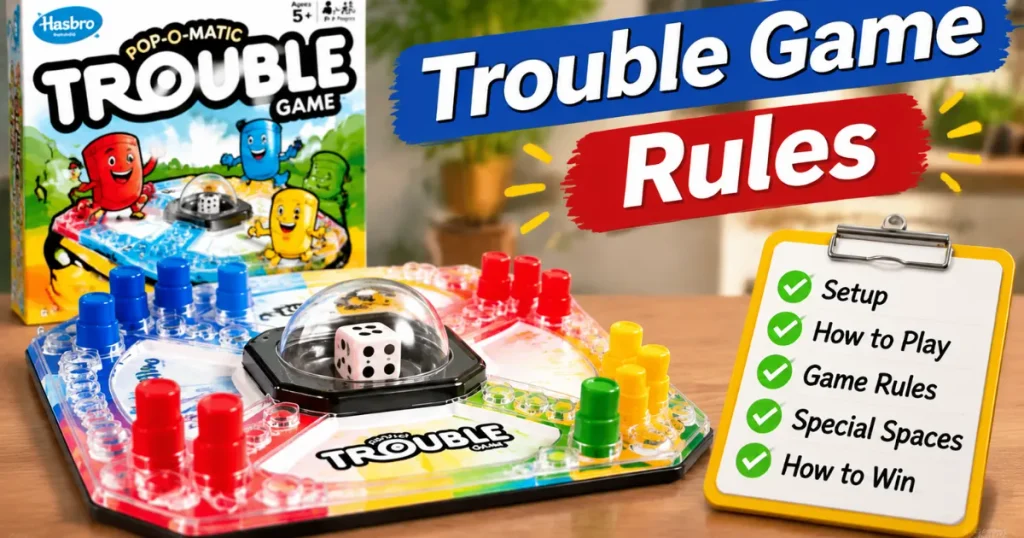
The main objective is simple: be the first player to move all four pegs into your Finish zone.
Players take turns pressing the Pop-O-Matic, checking the number, and moving a peg when a legal move is available.
How to Get a Peg Out of Home
In the classic Trouble rules, a player must roll a six to move a peg from Home onto their starting space.
If you do not roll a six, you generally cannot bring a new peg onto the track. Your turn passes unless another legal move is available under your edition’s rules.
Rolling a six also gives you another turn in the classic game.
How to Move Your Peg Around the Board
Once a peg enters the track, move it forward by the number shown on the die.
For example, if you roll a four, move one eligible peg forward four spaces. Count each space carefully and follow the direction of travel.
When you have multiple pegs on the board, choose the move that best supports your progress.
How to Bump an Opponent’s Peg
Trouble allows players to send opponents’ pegs back Home.
If your peg lands on a space occupied by an opponent’s peg, the opponent’s peg is returned to its Home area under the classic rules. That player must roll another six to bring it back onto the board.
This rule creates competition because one move can remove an opponent’s progress.
How to Enter the Finish Zone
After moving around the board, guide your pegs toward the matching colored Finish zone.
In classic Trouble, you need the exact number to move a peg into an open Finish space. You cannot move a peg beyond the end of the track or into another player’s Finish zone.
How to Win the Trouble Board Game
The winner is the first player to get all four of their pegs into their matching Finish zone.
Getting one or two pegs there is not enough. You must complete the full set to win.
Important Rule: Check Your Trouble Edition
Not every Trouble game follows exactly the same rules. Some editions include special spaces or different instructions for rolling a one and entering the Finish zone.
Special Spaces and Advanced Trouble Game Rules
Some versions of Trouble include special spaces that add extra movement options.
What Are Double Trouble Spaces?
A Double Trouble space gives a player another turn when their peg lands on it.
This creates an extra opportunity to move a peg, advance toward the Finish zone, or bump an opponent. Check the instructions supplied with your game for the exact bonus-turn rules.
What Are Warp Spaces in Trouble?
Warp spaces appear in certain Trouble versions. They let players move between connected spaces on the board.
They can change a peg’s position more quickly than ordinary movement. Their effects depend on the board and its instruction sheet, so do not apply Warp rules to a version that does not include these spaces.
Read Also: Georgia vs Alabama Game: Schedule, Time, and How to Watch
What Are Power Up Spaces?
Some newer Trouble editions offer Power Up Spaces as an alternative to classic gameplay.
These optional rules add more choices and variation to the basic race-and-chase format. Players can choose classic Trouble or the more challenging version when their instructions provide both options.
10 Winning Tips and Strategies for Trouble
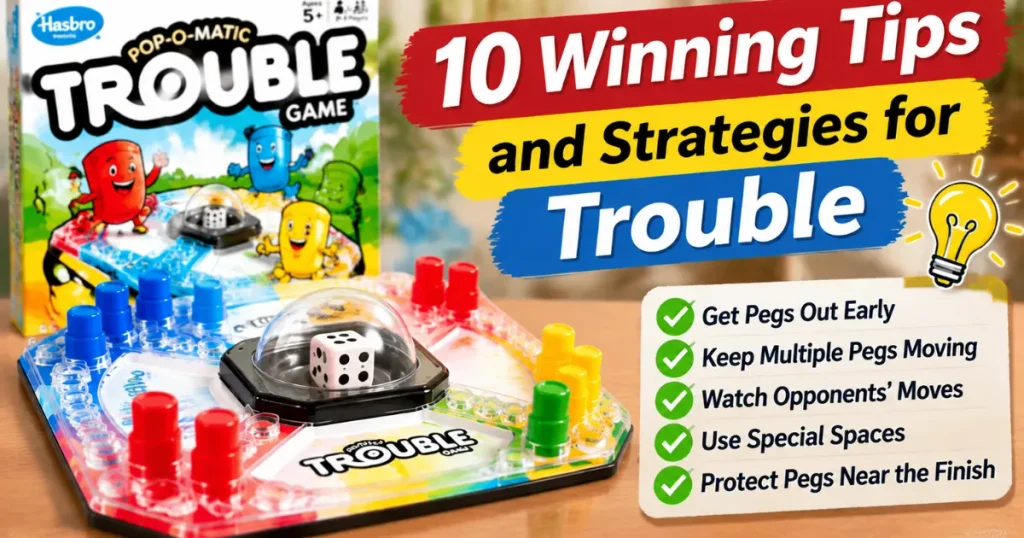
Trouble relies heavily on luck because players cannot choose their dice results. However, choosing which peg to move can still make a difference.
Get Your Pegs Out of Home Early
A peg in Home cannot make progress. When you get a valid starting roll, consider bringing another peg onto the track to create more movement options.
Keep Multiple Pegs Moving
Having several pegs on the board gives you more choices when you roll. You can advance different pieces instead of depending on one peg.
Watch Your Opponents’ Positions
Pay attention to opponents who are close behind your pegs. A move that looks safe now might leave your piece vulnerable on their next turn.
Bump Opponents When You Can
Landing on an opponent’s peg can send it back Home. When you have a choice, consider whether removing a leading opponent’s peg is more useful than making a small advance.
Choose the Right Peg to Move
Before moving, check all your available pegs. Compare which move brings you closer to Finish, avoids danger, or creates an opportunity to bump another player.
Protect Pegs Near the Finish
A peg that has traveled most of the board represents valuable progress. Look at the positions of nearby opponents before deciding which piece to move.
Use Special Spaces Carefully
Learn what Double Trouble and Warp spaces do in your edition. A special move can change your position, so understand its effect before making a decision.
Avoid Blocking Your Own Starting Space
If your edition prevents you from bringing another peg out while your Start space is occupied, moving the peg away can create room for another piece.
Balance Offense and Progress
Bumping an opponent can be useful, but advancing your own pegs is also important. Consider both options instead of always choosing the most aggressive move.
Stay Patient With Unpredictable Dice Rolls
The Pop-O-Matic controls the number you receive. You cannot guarantee a win, but you can make better choices with the movement available.
Is Trouble a Game of Luck or Strategy?
Trouble is mainly a luck-based game with simple strategic decisions. The die controls movement, while players decide which eligible peg to advance.
A player cannot control whether the Pop-O-Matic produces a one, four, or six. However, they can choose between available pegs and decide when to prioritize progress or bump an opponent.
How Much Strategy Does Trouble Require?
Trouble does not require complex planning. Its main decisions involve peg selection, opponent positions, and movement opportunities.
This makes it easier for younger players to understand than many strategy-heavy board games. However, the random dice results mean that careful decisions cannot guarantee victory.
Common Trouble Game Mistakes to Avoid
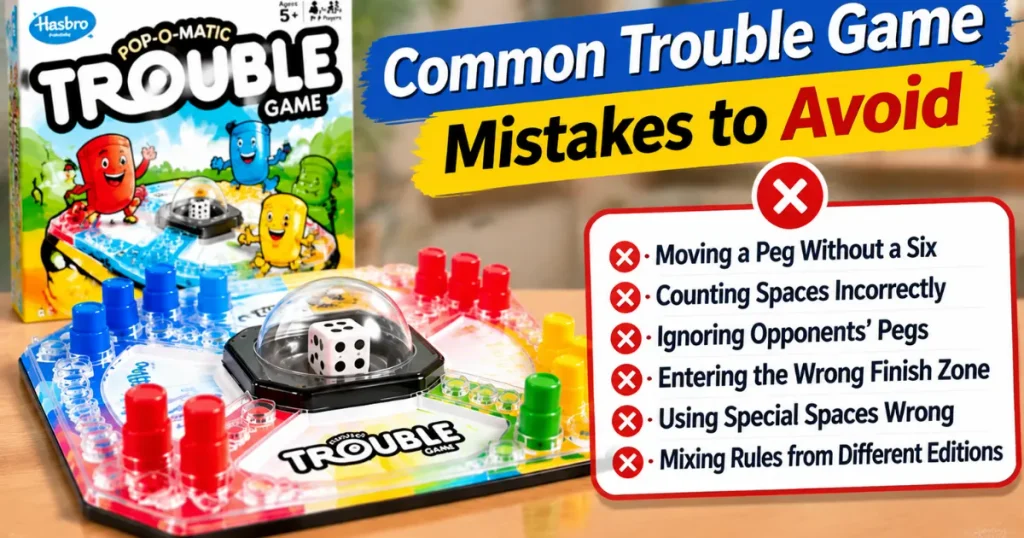
New players can make mistakes when they confuse the different board spaces or use rules from another edition.
- Moving a peg out of Home incorrectly: Check the starting requirement in your instruction sheet.
- Counting spaces incorrectly: Count each movement space carefully.
- Forgetting opponent bumps: Landing on an opponent’s peg can send it Home.
- Using the wrong Finish rule: Some editions require an exact count, while others use a different entry rule.
- Ignoring your other pegs: Check all available moves before choosing one.
- Mixing different editions: Do not combine classic rules with optional Power Up or special-space rules unless the instructions allow it.
Trouble Board Game Examples: Understanding Real Gameplay Situations
Here are a few simple examples to make the rules easier to understand.
Example: Bringing a peg onto the board
You have four blue pegs in Home. You roll a six and use the starting move allowed by your edition to bring one peg onto Start.
Example: Bumping an opponent
Your peg lands on a space occupied by a red peg. Under the classic bumping rule, the red peg returns to its Home area.
Example: Choosing between two pegs
You have one peg close to Finish and another near an opponent. Compare the available moves before deciding which one to advance.
Example: Completing the game
You have three pegs in your Finish zone and one still on the track. You must get the final peg into Finish to win.
Trouble vs. Sorry!: Are They the Same Game?
Trouble and Sorry! are not the same board game. Both use a race-and-chase format, but they have different movement systems and rules.
| Feature | Trouble | Sorry! |
| Movement system | Pop-O-Matic die roller | Cards |
| Main objective | Move four pegs to Finish | Move four pawns to Home |
| Starting movement | Depends on edition | Card-based |
| Opponent interaction | Bumping | Sending pawns back |
| Main element of chance | Dice rolls | Card draws |
| Gameplay | Simple race-and-chase | Card-based race-and-chase |
Which Game Is Easier for Younger Children?
Trouble has a straightforward number-based movement system. Children press the bubble, read the die, and move their pegs.
Sorry! uses cards with different movement instructions. Both games can suit families, but the better choice depends on the child’s age, reading ability, and familiarity with board games.
Which Game Is Better for Family Game Night?
Trouble is a practical choice for families who enjoy simple rules and quick turns. Sorry! offers a different experience for people who prefer card-based movement and its special card actions.
Neither game is automatically better for every family.
Is Trouble a Good Board Game for Kids?
Yes. Trouble is designed for children ages 5 and up and can also be played by adults. Its simple movement rules make it accessible to families with different levels of board game experience.
What Skills Can Children Practice While Playing Trouble?
Children can practice several basic skills:
- Counting: Moving pegs according to the number on the die.
- Number recognition: Identifying dice results.
- Turn-taking: Waiting for their turn.
- Decision-making: Choosing which peg to move.
- Patience: Handling unexpected results.
- Sportsmanship: Learning to handle winning and losing.
Is Trouble Suitable for Family Game Night?
Trouble supports 2–4 players, making it suitable for siblings, parents, and friends. It can also be used during playdates and after-school activities.
Is Trouble Safe for Younger Children?
The game contains small plastic pegs. Hasbro’s product information includes a choking hazard warning for children under three years old.
How Long Does a Game of Trouble Take?
The length of a Trouble game depends on the number of players, dice results, and how often players bump one another.
Games can take longer when players repeatedly send each other’s pegs Home. The best way to estimate playing time is to try a round with your group.
Trouble Board Game: Advantages and Disadvantages
Advantages of Playing Trouble
- Easy rules: Beginners can learn the basic gameplay quickly.
- Simple setup: The game does not require lengthy preparation.
- Interactive gameplay: Players can bump opponents’ pegs.
- Pop-O-Matic bubble: The built-in dice roller keeps the die in place.
- Family participation: Two to four players can enjoy the game.
- Basic learning practice: Children can practice counting and turn-taking.
Disadvantages of Playing Trouble
- Heavy reliance on luck: Players cannot control their dice results.
- Limited strategy: The game offers fewer planning options than complex board games.
- Repeated setbacks: A bumped peg must return home.
- Possible repetition: Some players may find the movement system repetitive.
- Player frustration: Losing progress can be disappointing, especially for younger children.
Why Do Some Players Dislike Trouble?
Not everyone enjoys games that depend heavily on random results. Some experienced board game players prefer deeper strategy, more control, and fewer setbacks.
The BoardGameGeek discussion titled Ludo/Trouble – probably the worst board game I’ve played represents this type of critical player perspective. However, individual opinions should not be treated as universal facts.
Where Can You Buy the Trouble Board Game?
If you want to buy Trouble in the USA, several retailers provide product information and purchasing options.
What to Check Before Buying Trouble
Before purchasing, check these details:
- Player capacity: The standard listing supports 2–4 players.
- Age recommendation: Look for ages 5 and up.
- Game components: Check that the board, Pop-O-Matic unit, and 16 pegs are included.
- Game edition: Confirm whether it includes classic rules or optional special spaces.
- Product condition: Check packaging and seller information, especially when buying used.
Is Trouble a Good Gift for Kids?
Trouble can make a suitable birthday or holiday gift for children aged five and older. Its colorful pegs, simple rules, and interactive dice roller make it a practical option for family game collections.
It can also be a good choice for playdates and family activities.
FAQ’s
How do you play the game of Trouble?
Each player chooses a color and places four pegs in their matching Home area. Players take turns pressing the Pop-O-Matic bubble and moving their pegs according to the die. The first player to move all four pegs into their Finish zone wins.
Is Trouble and Sorry the same game?
No. Trouble uses a Pop-O-Matic dice roller to control movement, while Sorry! uses cards. Both are race-and-chase board games, but they have different rules and gameplay features.
Is Trouble a good game for kids?
Yes. Trouble is recommended for children ages 5 and up. It provides opportunities to practice counting, number recognition, turn-taking, and basic decision-making while playing with family and friends.
Where can I find the game Trouble?
You can find Trouble through retailers such as Walmart and Dillons. You can also visit Hasbro’s official website for product information and buying options. Check current stock and available editions before purchasing.
Final Thoughts on Trouble Game Rules and Winning Tips
The Trouble board game combines simple rules, colorful pegs, and the famous Pop-O-Matic dice roller to create an easy-to-learn family game.
Understanding peg movement, opponent bumps, special spaces, and Finish rules can help you make better decisions. Although luck plays a major role, choosing the right peg to move can improve your chances.